
The piece everyone looks at
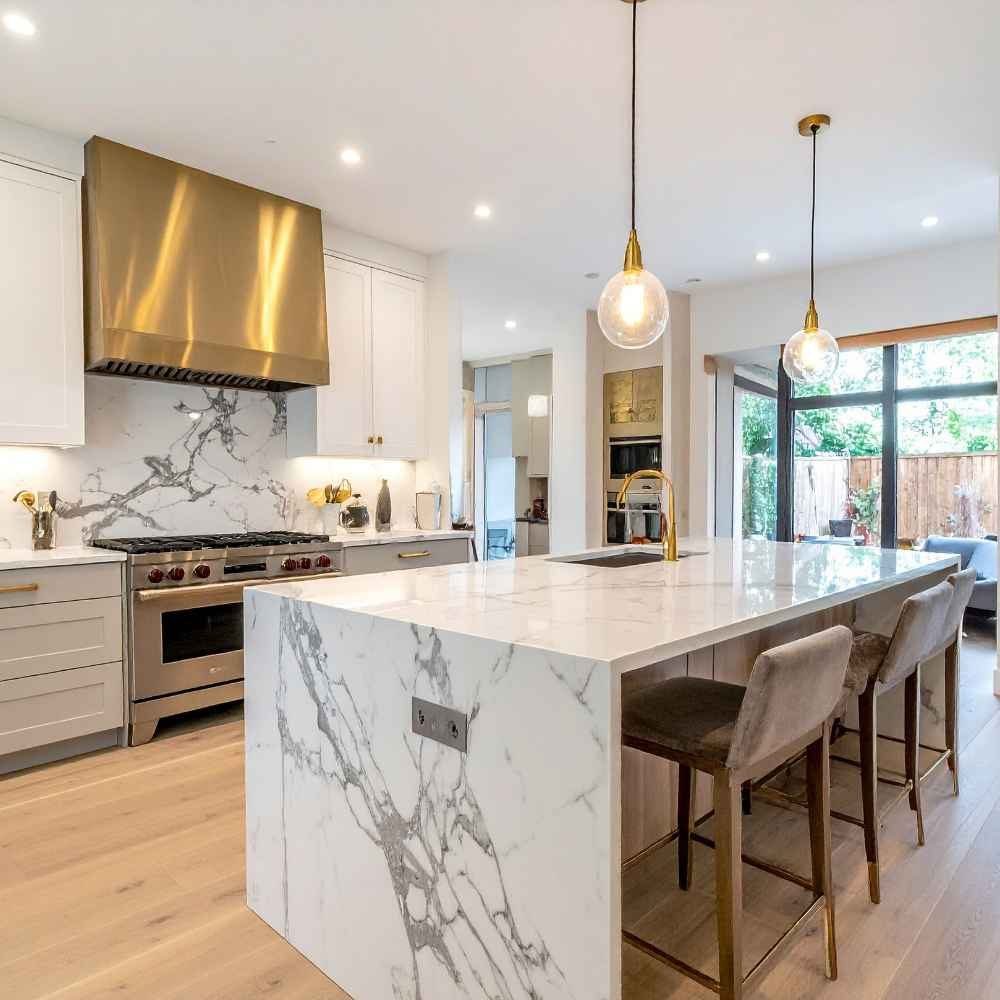
It’s the largest uninterrupted stone in the house and the first thing anyone sees. Worth spending the slab budget here and economising on the perimeter.
If your budget won’t stretch to your first-choice stone across the whole kitchen, put it on the island and run something quieter and cheaper around the perimeter. Designers do this constantly and nobody ever notices.
An island is also where the fabrication actually gets difficult. Long unsupported overhangs, mitred waterfall legs, book-matched veining and single-slab spans all live here, and all of them are the difference between an island that looks custom and one that looks assembled.
Three things to settle early: how far the seating side overhangs, whether you want a waterfall, and whether the whole top can come from one slab.
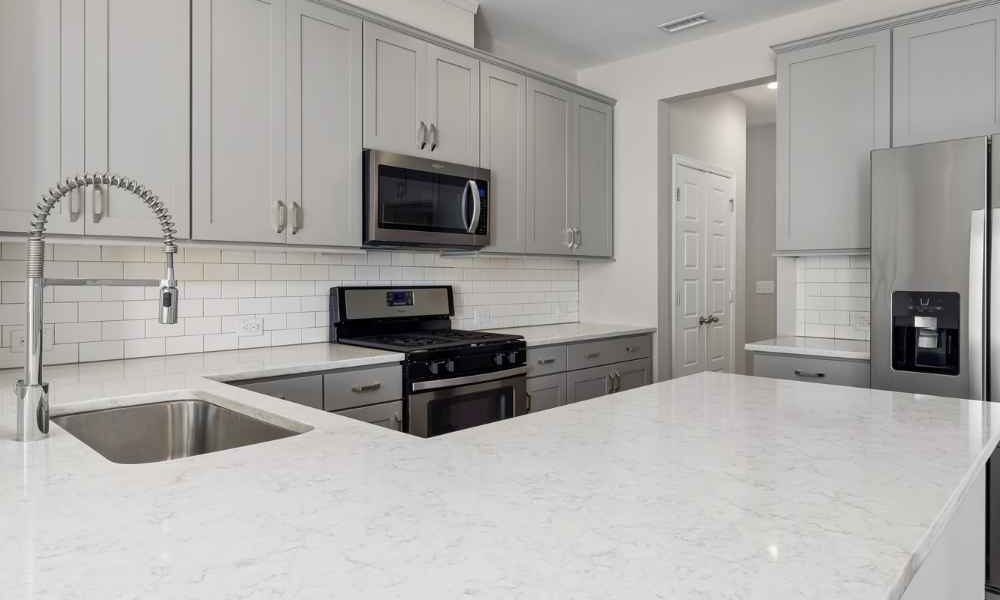
by material
Material decides your budget, your maintenance and roughly 80% of the final look. Room and layout come after.
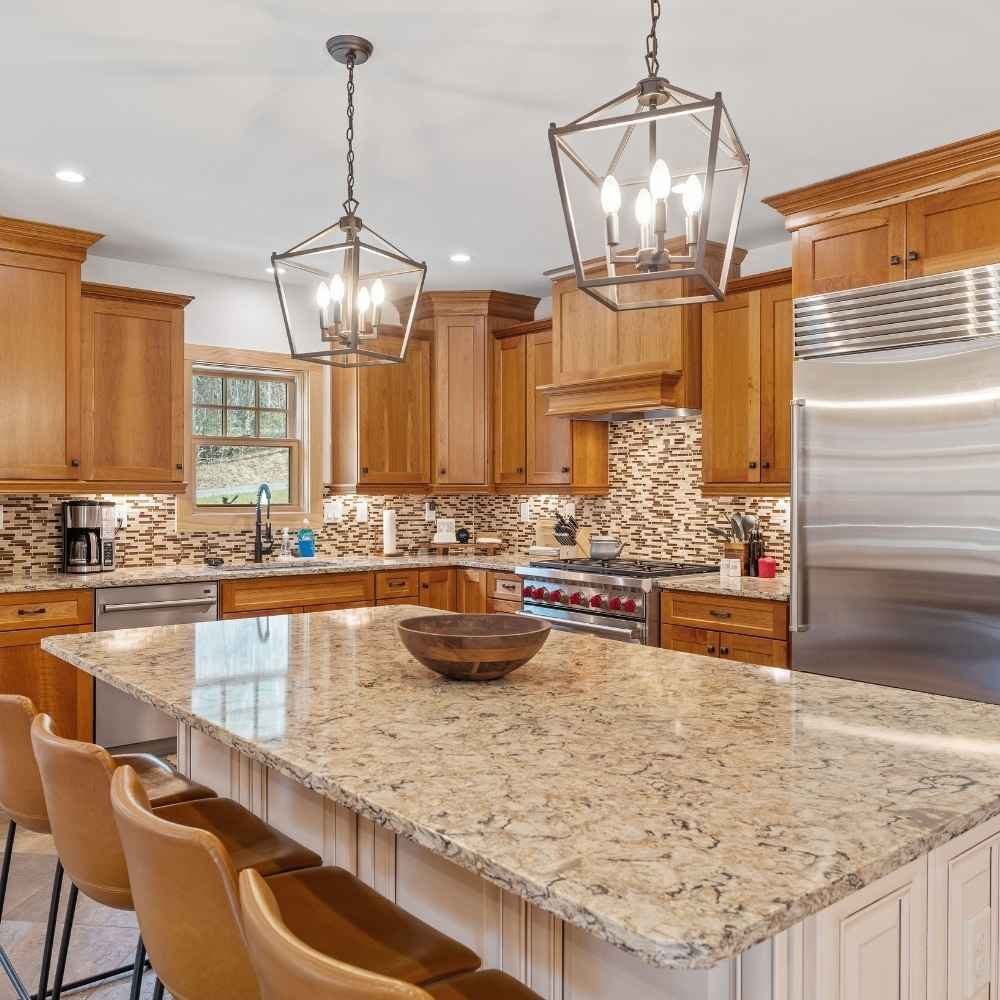
Hardest-working natural stone. Heat-proof, unique slab to slab, needs sealing once a year or so.
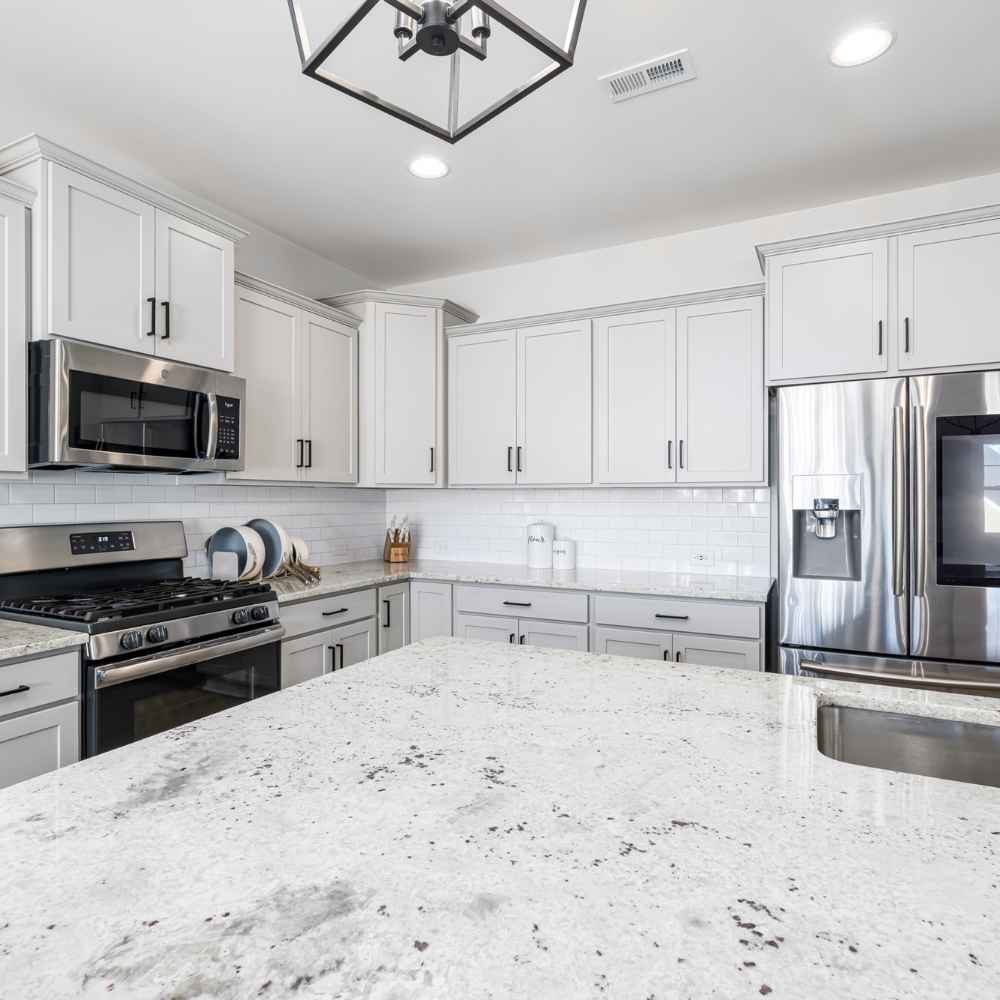
Non-porous, consistent, zero sealing. Calgary's most-requested surface — and the most forgiving.
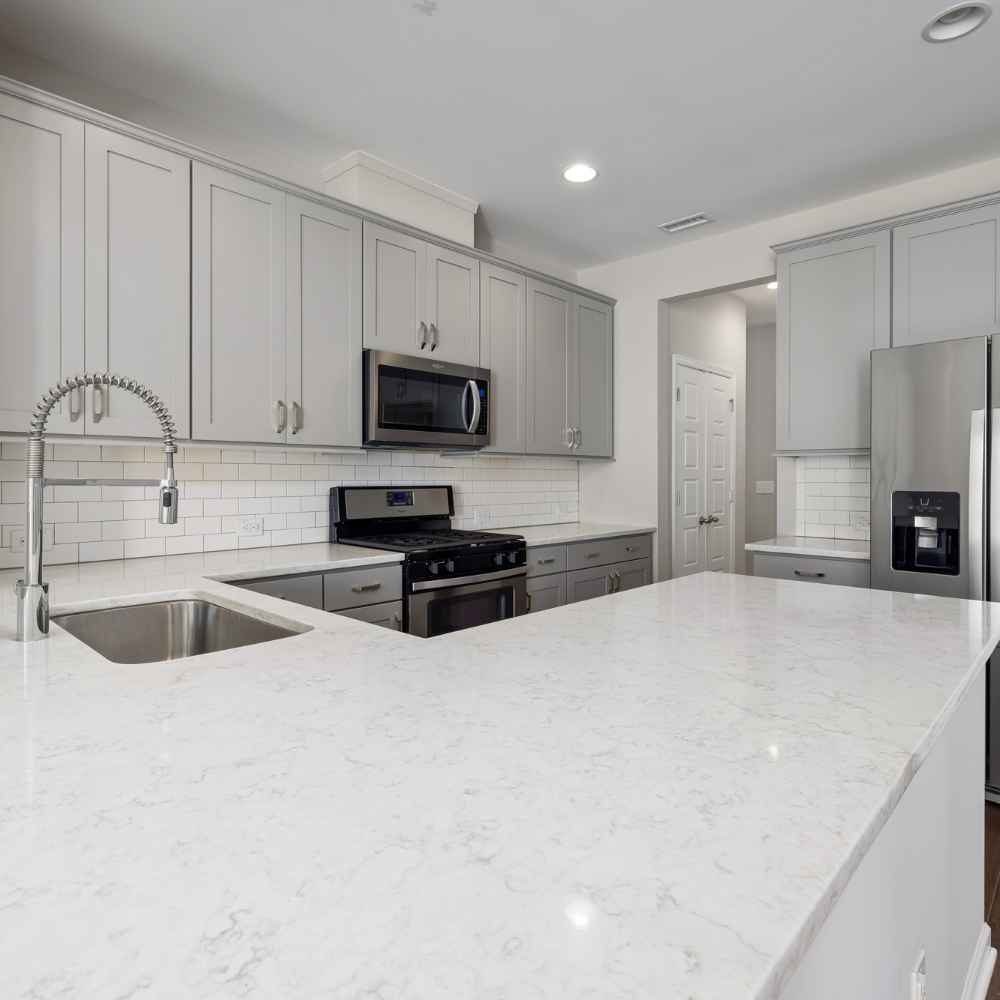
Nothing else looks like it. Etches and patinas are beautiful if you want it to age,
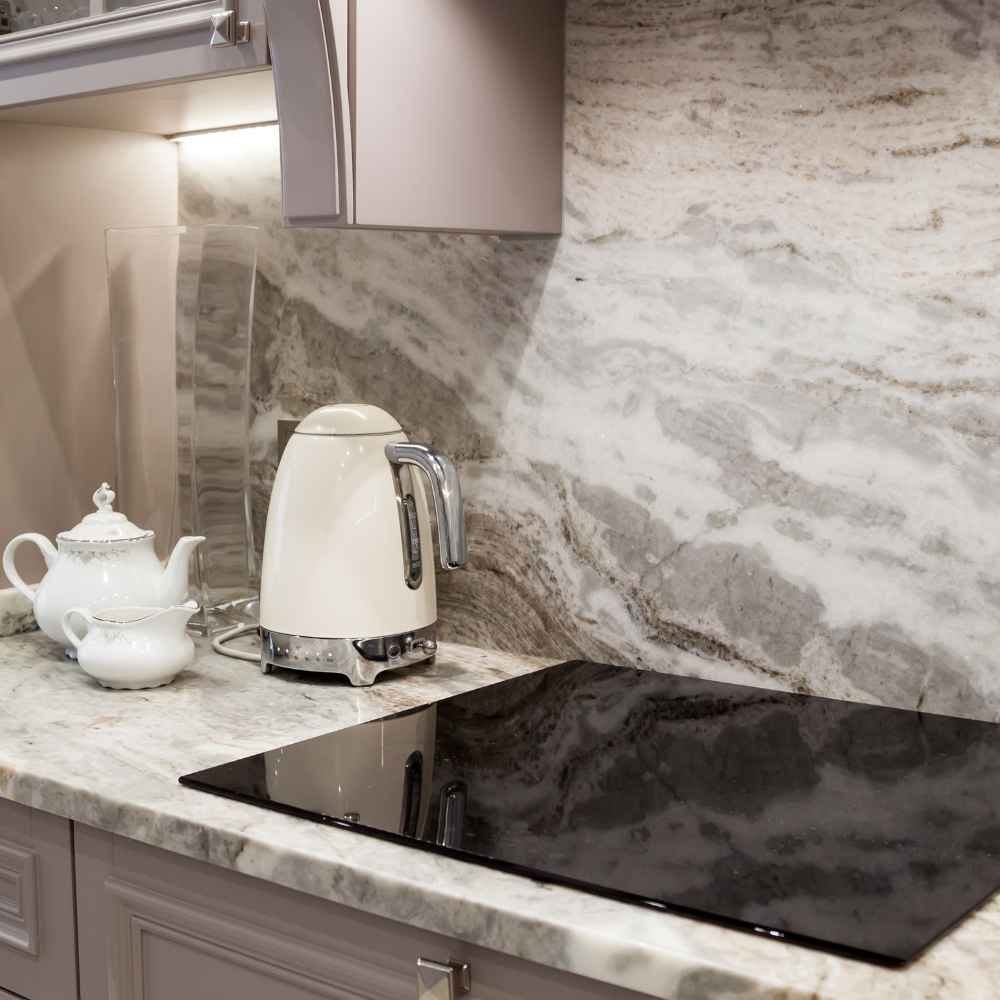
Marble's face, granite's durability. Genuinely hard — but half the market is mislabelled, so testing matters.
UV-stable, scorch-proof, only 6–12 mm thick. The right answer for outdoor kitchens and full-height slab walls.
Side by side
| Surface | Heat | Stains & etching | Sealing | Outdoors | Relative cost |
|---|---|---|---|---|---|
| Granite | Excellent — set a hot pan down | Resists staining once sealed; doesn’t etch | Yearly, 10 minutes | Yes | $$ |
| Quartz | Use a trivet — resin scorches near 150 °C | Non-porous; won’t stain or etch | Never | No — UV yellows it | $$–$$$ |
| Marble | Very good | Etches on contact with lemon, wine, vinegar | Every 3–6 months | Not recommended | $$$ |
| Quartzite | Excellent | Hard; true quartzite won’t etch | Yearly | Yes | $$$–$$$$ |
| Porcelain | Excellent — genuinely scorch-proof | Zero porosity | Never | Best in class | $$$ |
Cost bands are relative to each other, not fixed prices. Slab grade moves the number far more than material does.
Structure
People sit at islands and lean on them, and a stone slab cantilevered too far without support will eventually crack at the cabinet line. This is the most common structural failure we get called out to repair, and it is entirely preventable.
As a working rule, 3 cm stone handles roughly 250–300 mm of unsupported overhang. 2 cm handles about half that. Beyond those figures you need concealed steel flat-bar brackets set into the cabinet top, or visible corbels, or a knee wall. Steel is what we recommend — it disappears completely and it doesn’t eat the legroom that corbels do.
For comfortable seating, plan on about 380 mm of overhang per stool and 600 mm of width per person. That means most seating islands need support regardless of stone thickness. Budget for it at the design stage rather than discovering it at template.
Edge treatments
01.
3 cm of visible stone, clean and current. Cheapest, and correct in most modern kitchens.
02.
Two pieces mitred at 45° to give a 60–100 mm apparent thickness with a hollow core. Substantial look without the weight or the cost of solid stone.
03.
Stone turns at the end and runs to the floor. Mitred at the corner, and on veined material we book-match so the pattern continues down the leg. Adds a full slab’s worth of material.
04.
Profiled decorative edges. Right against traditional cabinetry, wrong against flat-slab doors.
Slab logistics
Standard slabs run roughly 2.8 × 1.7 m. Jumbo slabs, available in most quartz lines and in some natural stone, reach about 3.2 × 1.6 m. An island longer than that needs a seam, and on a large island a well-placed seam is entirely acceptable — we run it perpendicular to the long axis, away from the sink and away from the seating side.
Waterfall ends change the slab maths substantially. Each leg consumes material equal to the height of the island plus the mitre allowance, so a waterfall island frequently needs a second slab. Price that in early, because it’s a common source of budget surprise.
For book-matched veining — where the pattern mirrors across a seam or continues over a waterfall corner — the slab has to be selected and laid out for it from the start. Tell us at template. It cannot be added later.
/ FAQs
Roughly 250–300 mm in 3 cm stone, about half that in 2 cm. Beyond that, use concealed steel flat-bar brackets. Since comfortable seating wants around 380 mm, most seating islands need support — plan for it rather than pushing the limit.
Meaningfully more, yes. Each leg uses material equal to the island height, which often pushes the job into a second slab, and the mitred corners are labour-intensive to cut and polish. On veined stone you're also paying for careful slab layout to get the pattern to line up.
Up to about 3.2 m with a jumbo slab. Beyond that you need a seam. We'll tell you at quoting stage whether your dimensions fit a single slab, since it affects both price and layout.
Whatever you want to look at. Islands take less abuse than the perimeter run — less heat, less chopping — so this is where marble and dramatic quartzite become more defensible. If the island holds the cooktop, apply kitchen rules instead.
Not necessarily. Contrasting the island against the perimeter is a well-established move and it lets you spend the slab budget where it shows. A dramatic island with a quiet perimeter usually reads better than the same stone everywhere.
Steel flat bar spans the opening and ties into the cabinet structure on both sides, so nothing bears on the appliance. We work this out at template once we can see the actual cabinet configuration.
Free measure and quote across Calgary, Airdrie, Cochrane, Chestermere and Okotoks. No obligation, no showroom pressure.
Crescent Granite templates, fabricates and installs custom kitchen and bathroom countertops across Calgary — in-house, on schedule, and built to outlast the reno.
Copyright © 2026 Crescent Granite